
Guanaja Scuba Diving

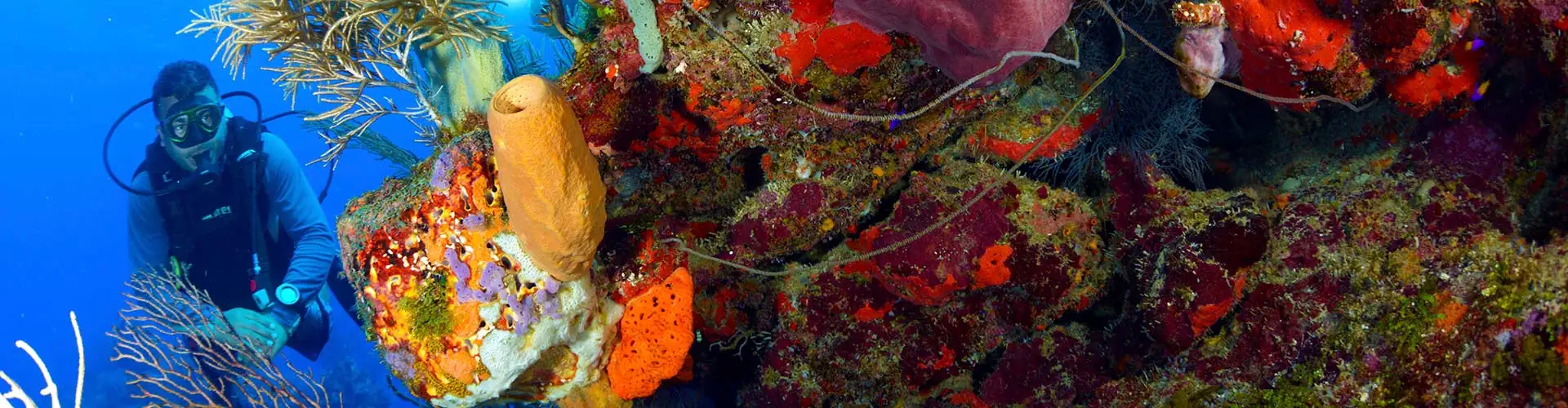
Guanaja’s fringing reef is a protected marine reserve, making it an ideal spot for scuba diving and snorkeling nearly anywhere offshore the mainland. Part of a volcanic and coral mountain range called the Bonacca Ridge, Guanaja marks the second-largest barrier reef globally – the Mesoamerican Barrier Reef.

Guanaja’s fringing reef is a protected marine reserve making it an ideal spot for scuba diving and snorkeling off all coastlines.

The island of Guanaja fringing reef is a protected marine reserve making it an ideal spot for diving and snorkeling nearly anywhere offshore the mainland. It offers a mixture of pinnacles, vertical walls, lava tunnels and wrecks including the nearby Jado Trader, one of the most sought-after wrecks in the Caribbean. It is similar to the diving that made Roatan famous, but shared with only a fraction of the number of divers.

Manic for Macro!

At some point in most divers' diving life cycle, seeing "lots of fish" just isn't enough.  When you've mastered your buoyancy control to the point that you can hover motionless and begin to understand the allure of underwater treasure hunting for the magic macro critters.

For macro lovers, the thrill of the dive comes from finding critters that offer fascination in spades despite their diminutive size. Those small things are tough to notice unless we slow down and take our time looking in the nooks and crannies, the rubble, and the sand.

Luckily for our guests, Guanaja offers some of the best macro life in the Caribbean. We want to share with you a few of our favorite creatures, found by our dive guides. We also have additional images in the gallery, taken by Mickey Charteris, underwater naturalist, photographer, and author of the marine species identification book Caribbean Reef Life. 

Let's test some of your critter and fish ID skills!

Roughback Shrimp

Roughback Shrimp

caribbean-pipefish

Caribbean-pipefish

ornate-elysia

Ornate-Elysia

Gaudy Clown Crab

Gaudy Clown Crab

Black Spotted Nudibranch

Black Spotted Nudibranch

sargassum-nudibranch

Sargassum Nudibranch

Lettuce Slug

Lettuce Slug

Curve Nosed Neck Crab

Curve Nosed Neck Crab

Pipehorse

Pipehorse

Red Tipped Sea Goddess

Red Tipped Sea Goddess

Cryptic Teardrop Crab

Cryptic Teardrop Crab

white-spotted-aeolid

White-Spotted-Aeolid

The Reef Crest is the Best!

The shallow reef areas in Guanaja and surrounding cayes are some of the most vibrant in the western Caribbean. Thick patches of pillar, elkhorn, lettuce and blade coral are interspersed with azure vase, red & green rope and huge barrel and endless encrusting sponges. There are also more purple sea fans per square foot than we have seen anywhere else!  This substrate - already stunning in and of itself - is then inhabited by an amazing amount of  marine life. Much of it doing its best to hide.  All of it bathed in the natural light that makes the colors pop. Don't be in a rush to dive deeper!  The shallows are where the true beauty lies and the majority of the fish life!

seafans in shallow water
reef fish in shallow water
blue tangs

Our Underwater Tunnels and Arches

Cathedral, Black Rock Canyon, Sandi's Reef and Wonderful are just a few of the moored dive sites featuring some amazing swim-throughs.  There’s nothing quite like the experience, finning along as beams of light randomly pierce through the formations. 

If it's summer, you may even be treated to annual spawning of the Silversides.  Millions of the Atlantic silversides will swell together for their annual spawning May - July. About five to 20 days later, newborns are hatched and travel in massive swells of schools that can fill the many swim throughs and caverns prolific around Guanaja. Fin forward, and the school parts in front of you. Hover and become entirely and symmetrically encircled by fish as they move in unison as if they are a single creature. Such a treat!

silversides in grotto
diver behond passthrough
pass-through
diver behind tunnel

Hidden in Plain Site

The creatures that can be found, "hidden in plain site" in Guanaja's sand and rubble areas are just as amazing, if not more so, than the nudibranchs!

Rubble zones provide hiding places for octopus but they are also home to many more unique creatures that burrow or camouflage themselves.  Often overlooked (but not by our dive guides!) divers are urged to swim slowly over these areas to see what they can find.

Scaly-Tailed-Mantis-Shrimp

Scaly-Tailed-Mantis-Shrimp

Unknown decorator crab

Mystery Decorator Crab

Rough Box Crab

Rough Box Crab

Fringed-Filefish

Fringed Filefish

The Outer Reef Slope

Diving along the walls at depths around 60' - 70' feet is a favorite among those who love to investigate for creatures that hide between the cracks and crevices.  Be sure to take time to look into the open water away from the reef wall for a passing ray or shark. At this depth, less sunlight means you're less likely to see many large reef fish.  But the cracks, crevices, and sponges provide habitat for many invertebrate species (including crabs and shrimps) and some smaller fish (including gobies, cardinalfishes, and other species).

You are also likely to see a healthy population of tunicates, especially the Blue Bell and Painted Tunicates.  Did you know that these animals - found frequently at our dive sites - are our closest invertebrate relatives? Although tunicates are invertebrates, they belong to the Phylum Chordata, which also includes animals with backbones, like us. That makes us distant cousins. Who knew!

Lionfish Hunting

When it comes to hunting lionfish, we are all in!  We hunt for these nasty creatures on every dive. We also encourage our guests to help us find and eliminate them.  You can support us by simply pointing out any you see. Additionally, you can try your hand spearing your own with a ZooKeeper.  The Zookeeper Lionfish Container unit is a high-quality product that provides near-puncture-proof storage for your lionfish while diving. We'll give you instructions beforehand, and then off you go!  The bonus for everyone: the tasty treats our chefs will come up with to feast on them later!  Lionfish ceviche, lionfish fingers for appetizers, lionfish sandwiches for lunch, to name just a few ways to eat this delicious fish.  (Payback!)

diver pointing out a special fish
Lionfish
lionfish haul
lionfish fritters

The Wreck of the Jado Trader

The 240-foot Jado Trader was a refrigerator freighter sunk in 1987.  Nearly 30 years later, it has formed one of the richest artificial reefs in Guanaja. The Trader rests on a sandy bottom, completely intact and in waters between 80 and 110 feet (24 – 33 meters), suitable for experienced divers. The wreck is nicely encrusted and home to a variety of marine critters.  The dive returning from the wreck is along a shallow reef teeming with life.